Many traders spend hours studying indicators, candlestick patterns, support and resistance, and various trading strategies. However, in practice, the ability to read the market alone is not always enough to make trading results consistent.
The problem often does not come from the strategy, but from how traders make decisions when real money is actually at stake.
This is why in the world of trading, psychology is often considered just as important—sometimes even more important—than technical analysis skills themselves.
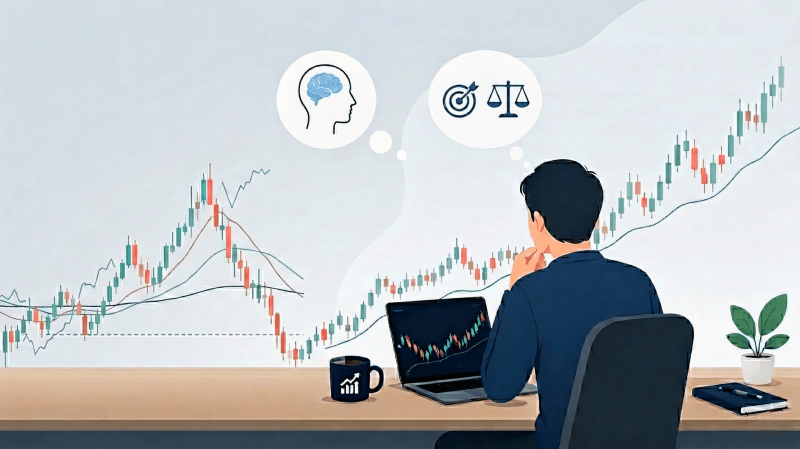
Why Can the Same Analysis End Differently?
Interestingly, two traders can use exactly the same strategy, from entry to exit.
But the final results can still be very different.
One trader remains calm and follows the plan, while the other starts to hesitate, changes decisions midway, or exits too early due to emotional pressure.
This difference is not caused by a lack of technical knowledge, but by how each trader responds to an uncertain market.
This is also often seen in the basic mistakes commonly made by beginner traders in their trading journey, as discussed in the article about common mistakes beginner traders make in forex trading.
Trading Psychology Is More Than Just Emotions
Many people think trading psychology is only about “not being emotional.” In reality, it is far more complex.
Trading psychology includes how a trader processes risk, uncertainty, and the outcome of every decision made.
- How to respond to floating profit and loss
- How to face markets that do not match expectations
- How to maintain decision consistency
- How to stick to a plan under pressure
At this point, risk management becomes a crucial factor that often determines whether trading decisions remain stable or not. You can learn more in the discussion about How to Effectively Manage Risk in Forex Trading.
When the Market Starts “Testing” Traders
At the beginning, trading often feels easy because everything looks clear on the chart.
However, once a position is opened, the situation changes.
Price starts moving against expectations, and at that moment traders are faced with decisions that are no longer fully rational.
Some close positions too early, while others hold too long without a clear reason.
In many cases, this condition is closely related to underdeveloped risk understanding in trading, as discussed in the article about What Are the Risks in Forex Trading That You Should Know?.
Expectations That Quietly Change Trading Behavior
One of the most unnoticed factors for traders is their expectations of results.
When expectations are too high, every market movement feels more emotional.
Small profits feel insufficient, while small losses feel very disturbing.
This is where many traders start making decisions that no longer follow their original plan.
This phenomenon also often causes traders to misunderstand realistic profit potential in trading, which is discussed more realistically in the article can forex trading make someone rich?.
Why Experience Alone Does Not Guarantee Consistency
Many people think that the longer they trade, the more stable their results will be.
However, this is not always the case.
Without proper evaluation, experience can simply repeat the same patterns in different forms.
That is why some traders continue to experience ups and downs even after being in the market for a long time.
Building a More Stable Mindset
Consistency in trading does not come from one big change, but from small habits that are continuously trained.
- Learn to recognize your reactions during trading
- Focus on process, not only results
- Accept that every trade is part of probability
- Keep expectations realistic
The more a trader understands that trading is a long-term process, the more stable their decision-making becomes.
Conclusion
Trading is not only about how good the analysis is, but also about how decisions are made in uncertainty.
Trading psychology does not remove risk, but helps traders stay consistent in facing market dynamics.
In the end, differences in trading results are often not about the strategy itself, but about how the strategy is executed in real conditions.


