In the world of forex trading, there are many strategies used by traders to deal with market movements. One of the most commonly used techniques by beginner traders is averaging. This strategy looks simple because traders only need to add positions when the price moves against the previous entry direction.
For some traders, averaging is considered a quick way to recover losses and speed up the return to profit. In fact, many traders feel that this strategy almost always works when the market eventually reverses.
However, behind its simplicity, averaging is a trading technique that carries very high risk if used without proper forex risk management. Many trading accounts are wiped out not because of a wrong initial analysis, but because of excessive use of averaging without clear limits.
Therefore, it is important for beginner traders to understand how averaging works, its advantages, disadvantages, and hidden risks before using it in forex trading.
What Is Averaging in Forex Trading?
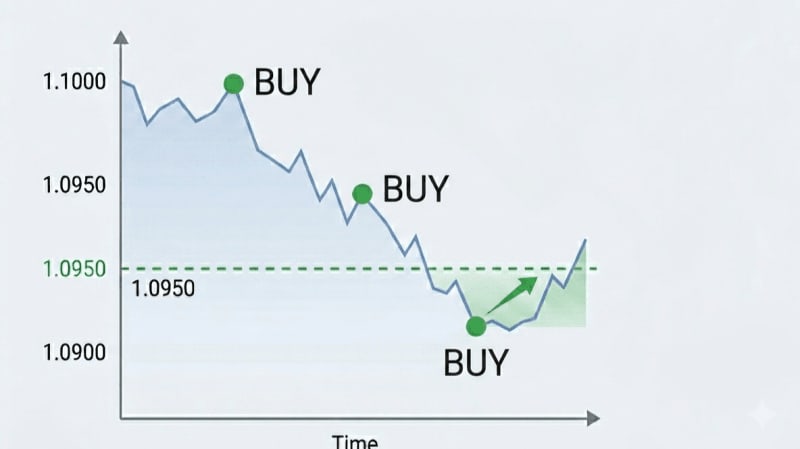
Averaging is a technique of adding trading positions when the price moves against an existing open position. The main goal of averaging is to improve the average entry price so that traders do not need a large price movement to return to profit or break even.
For example, a trader opens a buy position on EUR/USD at 1.1000. However, the price drops to 1.0950. The trader then opens a second buy position at a lower price.
With the additional position, the trader’s average entry price becomes lower than the first position. If the price rises slightly, the trader has a faster chance to return to profit.
This concept is what makes averaging attractive to many beginner traders.
Why Is Averaging So Popular?
Averaging has become a popular strategy because it is easy to understand and often produces profits in certain market conditions.
Some reasons why averaging is widely used include:
- Easy to apply even for new traders.
- Does not require complex technical analysis.
- Provides hope that positions can return to profit.
- Often works when the market experiences retracements.
- Widely used in trading robots or EAs.
In addition, psychologically, averaging makes traders feel like they are not fully in loss because the position can still be “saved.” This is why many traders continue averaging without realizing that the risk is increasing significantly.
How Does Averaging Work?
In simple terms, averaging works by adding positions at different price levels to achieve a better average entry price.
Example:
- First buy: 0.01 lot at 1.1000
- Price drops to 1.0950
- Second buy: 0.01 lot at 1.0950
With these two positions, the average entry becomes around 1.0975.
This means the trader does not need the price to return to 1.1000 to break even. If the price rises to around 1.0975, the position is already balanced again.
This is why averaging is often considered helpful for speeding up floating loss recovery.
Types of Averaging
1. Buy Averaging
Buy averaging is used when a trader adds additional buy positions as the price moves lower than the previous entry.
This strategy is usually used when the trader believes the price will rise again.
2. Sell Averaging
Conversely, sell averaging is used when a trader adds additional sell positions as the price moves higher than the previous sell position.
The trader expects the price to eventually fall so all positions can be closed in profit.
3. Fixed Lot Averaging
In this method, traders use the same lot size for each additional position.
This approach is relatively safer compared to aggressively increasing lot sizes.
4. Martingale Averaging
In the martingale method, traders increase lot sizes every time a position goes into loss.
Example:
- First position: 0.01 lot
- Second position: 0.02 lot
- Third position: 0.04 lot
This method can speed up profit recovery, but it is extremely dangerous because losses can increase very quickly.
Advantages of Averaging Strategy
1. Helps Speed Up Break Even
By improving the average entry price, traders can reach break even faster compared to holding a single position.
2. Works Well in Sideways Markets
When the market moves within a range, averaging is often effective because price tends to return to the average area.
3. Does Not Require Complex Analysis
Many beginner traders like averaging because it is simpler compared to complex trading strategies.
4. Provides Entry Flexibility
Traders can take advantage of better prices when the market temporarily moves against the initial position.
Risks of Averaging When Misused
1. Very Large Floating Loss
This is the biggest risk of averaging. When the market continues moving against the trader without a clear reversal, floating loss keeps increasing.
The more positions are added, the larger the total loss becomes.
2. Margin Can Run Out Quickly
Each additional position requires extra margin. If traders use high leverage without proper lot control, accounts can quickly face margin calls.
That is why traders need to understand lot, spread, and leverage in forex before using averaging strategies.
3. Dangerous in Strong Trending Markets
Averaging often fails when the market is strongly trending.
For example, continuously averaging buys in a long bearish market can lead to severe account pressure as price keeps falling without significant reversals.
4. Encourages Overtrading
Many traders open positions too frequently in hopes of a quick reversal.
This can lead to excessive margin usage and increase the risk of account blowout.
5. Emotionally Difficult to Control
Averaging often makes traders struggle to accept losses.
Instead of cutting losses, traders keep adding positions hoping the market will reverse. This often leads to even bigger losses.
Why Do Beginner Traders Fail Because of Averaging?
Many beginner traders only focus on the profit side of averaging without understanding long-term risks.
After a few successful averaging trades, traders may believe the strategy is always safe.
However, the forex market does not always move back and forth. Sometimes it trends strongly for long periods without significant retracements.
In such conditions, averaging can destroy a trading account very quickly.
In addition, many beginners do not set a maximum limit for averaging, leading to uncontrolled position stacking.
When Can Averaging Be Used?
Although risky, averaging is still used by some professional traders with strict rules.
It is usually used when:
- The market is in a ranging condition.
- The trader has large capital.
- Lot sizes are very small.
- A maximum averaging limit is set.
- The trader understands market structure well.
Without these conditions, averaging is more risky than profitable.
Safe Tips for Using Averaging
1. Use Small Lot Sizes
Small lot sizes help keep margin safe when the market moves against the position.
2. Set a Maximum Limit for Positions
Do not average without limits. Define how many positions you are willing to open.
3. Avoid Averaging in Strong Trends
If the market is strongly trending, it is better to avoid averaging because floating loss risk increases significantly.
4. Always Use Stop Loss
Many averaging traders avoid stop loss because they expect the market to return.
However, using stop loss and take profit is still essential to protect the account from extreme losses.
5. Understand Risk Management
Before using averaging, traders must understand forex risk management to control capital properly.
Is Averaging Suitable for Beginners?
In theory, averaging is easy to understand for new traders. However, in terms of risk, it is actually not suitable without experience and proper market understanding.
Beginners often focus too much on the hope that the market will reverse, without considering long trending conditions.
Therefore, new traders should first focus on trading basics, money management, and disciplined stop-loss usage before trying averaging strategies.
Conclusion
Averaging is a popular trading technique because it is simple and easy to understand. It works by adding positions when the price moves against the initial entry to improve the average entry price.
In certain market conditions, averaging can help traders recover floating losses faster and reach break even sooner.
However, despite its advantages, averaging carries significant risks if used without proper risk control. Large floating losses, margin calls, and account blowouts are the main risks of this strategy.
Therefore, traders must understand capital management, market conditions, and risk limits before using averaging in forex trading to avoid becoming part of common beginner forex trading mistakes.


